

 Wróć
Wróć In an era of increasing quality requirements and time pressure in electronics manufacturing, the process of creating a BOM (Bill of Materials) is one of the key stages that determines project success. An improperly prepared BOM can lead to assembly errors, delays, and increased costs. In this article, we will walk you through how to build a correct BOM that is clear, complete, and aligned with industry standards step by step.
What is a BOM and why does it matter?
A BOM (Bill of Materials) is a document that contains a list of all components required to build an electronic device. It serves as a kind of “recipe” that includes:
- component names,
- manufacturer part numbers,
- quantities,
- parameter values (e.g. resistance, capacitance),
- additional information such as tolerances, final assembly, or alternative part numbers.
A well-prepared BOM in electronics manufacturing facilitates collaboration between procurement, manufacturing engineering, and assembly partners, for example within services such as SMT assembly.
Key principles of BOM preparation
1. Use of unambiguous identifiers
Each item in the BOM should have a unique identifier. A good practice is to label components according to conventions such as “R”, “C”, and “U” for integrated circuits. Avoid generic names such as “10k resistor” and specify the manufacturer and part numer instead.
2. Inclusion of alternatives and substitutes
In real-world production, it is advisable to define alternative components. If a specific part is unavailable from a supplier, alternatives with similar parameters (e.g. identical value, tolerance, and package) can streamline order fulfillment.
3. Precise values and parameters
In a BOM for electronics manufacturing, not only component names matter, but also their values and technical parameters.
You should specify:
- resistances and tolerances,
- capacitor values,
- connector types and parameters,
- package standards (e.g. SMD, THT).
These details are essential to avoid errors during the assembly process.u.
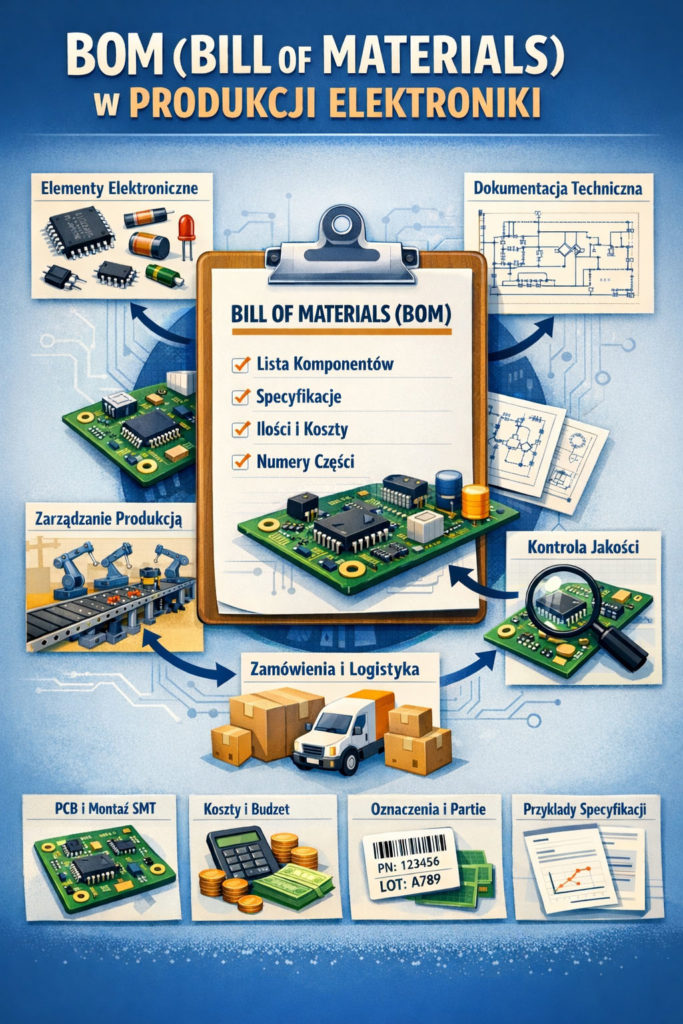
How to use values and tools in a BOM – practical examples
The role of mathematical data in BOM optimization
When designing circuits, relationships between component values are often analyzed – for example in filters, voltage dividers, or resistor networks. Tools using cosine and other trigonometric functions can help determine signal characteristics and optimize component selection.
While not every BOM includes such calculations, understanding their significance can improve design decisions and influence final parts selection.
Integration with manufacturing technology
When preparing a BOM, it is important to understand the production processes that will be used. Knowledge of the assembly technologies – such as SMT – allows you to match component types with manufacturing capabilities.
Mismatches between the BOM and technology can lead to:
- the need for manual assembly,
- costly rework,
- additional testing.
BOM quality control – checklist
Before releasing a BOM to production, it is worth performing a few simple checks:
- Does each component have a name, manufacturer, and a part number?
- Are component values clear and complete?
- Are quantities defined for each item?
- Are alternatives and substitutes included?
- Is the BOM aligned with the planned manufacturing services and technological capabilities?
Such quality checklists can significantly reduce the risk of errors during order execution.
